
Records Management for Australian Schools: Retention, Disposal and Compliance
Records Management for Schools
Every school creates records every day. Enrolment forms, medical action plans, immunisation records, incident reports, suspension letters, academic results, staff files and policy documents all accumulate year after year. Many contain sensitive information about children, and some must be kept for a very long time.
Yet many schools still rely on paper files, shared network drives, email and their school management system to manage these records. These approaches may work when a school is small, but they become risky as obligations grow, particularly around child safety, privacy and funding compliance.
This is where a records management system becomes essential.
Records management is the discipline of deciding how long each type of record must be kept, protecting it for that period, and then disposing of it properly and provably. A good system ensures that school records are:
• Captured, reviewed and approved before being declared a record
• Classified correctly and kept for the right length of time
• Protected from unauthorised access, modification or premature destruction
• Protected from destruction when a complaint or investigation subjects a record to a legal hold
• Disposed of only with proper authorisation, and with evidence
In simple terms, the school can prove that it kept what it was required to keep, and destroyed only what it was permitted to destroy.
Why record keeping matters so much for schools
Independent Schools Queensland (ISQ) publishes a guide to record management for independent schools. It points to the Royal Commission into Institutional Responses to Child Sexual Abuse, which highlighted the importance of accurate, complete and retrievable records in supporting victims of abuse, and to privacy obligations that include protecting personal information and destroying or de-identifying it in certain circumstances. It also notes that Commonwealth funding rules require schools to keep records, including enrolment and attendance records, for set periods.
Moreover, in our experience, many organisations do not systematically track which records are due for disposal review. As a result, they may be retaining considerable volumes of records unnecessarily. This creates avoidable costs, such as filing cabinets onsite, or in some cases offsite storage with ongoing fees, or greater volumes of digital storage. There is also business risk. Retaining records containing sensitive information for longer than the mandated period increases exposure if that information is ever compromised.
The risks of relying on hard copy records
Paper still plays a role in most schools, but relying on hard copies creates real risks:
• Fire, flood and other disasters can destroy records permanently, with no backup
• Accidental destruction by well-meaning staff, or through a clean-out of a storage room
• Misplaced or misfiled records that cannot be found when they are needed
• Slow, manual searching when a record needs to be located, often under time pressure
• Limited access control, as anyone with the key can open the filing cabinet
When a record is needed urgently, whether for a parent request, an audit or an investigation, the cost of not being able to find a record can be significant.
Why school management systems are not enough
School management systems are widely used, and for good reason. They are excellent platforms for storing structured data about students, such as enrolment details, contacts, attendance and results. Some also offer file storage alongside that core data.
But, file storage does not equate to robust document and records management.
Take a student incident report as an example. The document is created and drafted, then sent for review and approval before it is finalised and declared a record. A school management system will not typically facilitate that lifecycle, or the transition from document to record.
A robust system like M-Files will send the report to the appropriate person for review and approval, convert it to PDF automatically on approval, and apply the correct retention schedule and access permissions once it has been declared a record. The record is then protected against unauthorised access, modification or premature destruction.
Key Benefits of a Robust School Records Management Solution
A robust school records management solution should deliver the following benefits:
1. Metadata-driven classification and retrieval
ISQ's school records management guide makes the case that folders on a network drive are not adequate. Without files being classified and tagged with metadata, consistently applying retention and disposal is virtually impossible in all but the smallest schools. Metadata also enables instant search and retrieval, saving administration staff considerable time when a record needs to be surfaced.
2. Retention schedules linked to disposal authorities
Adding complexity is the wide range of legislation and internal policies that govern when a record can be disposed of, how long it must be kept, and what trigger event starts the retention clock, such as a student graduating. These are known as disposal authorities.
Good practice links a disposal authority to each record, so the staff responsible can clearly see which legislation or policy governs its disposal. A robust solution does this using metadata, linking individual records to a retention schedule and the underlying disposal authority. These links should be built into the system so that classification is fully automated, freeing end users from the burden of classifying records correctly.
3. Disposal review and authorisation
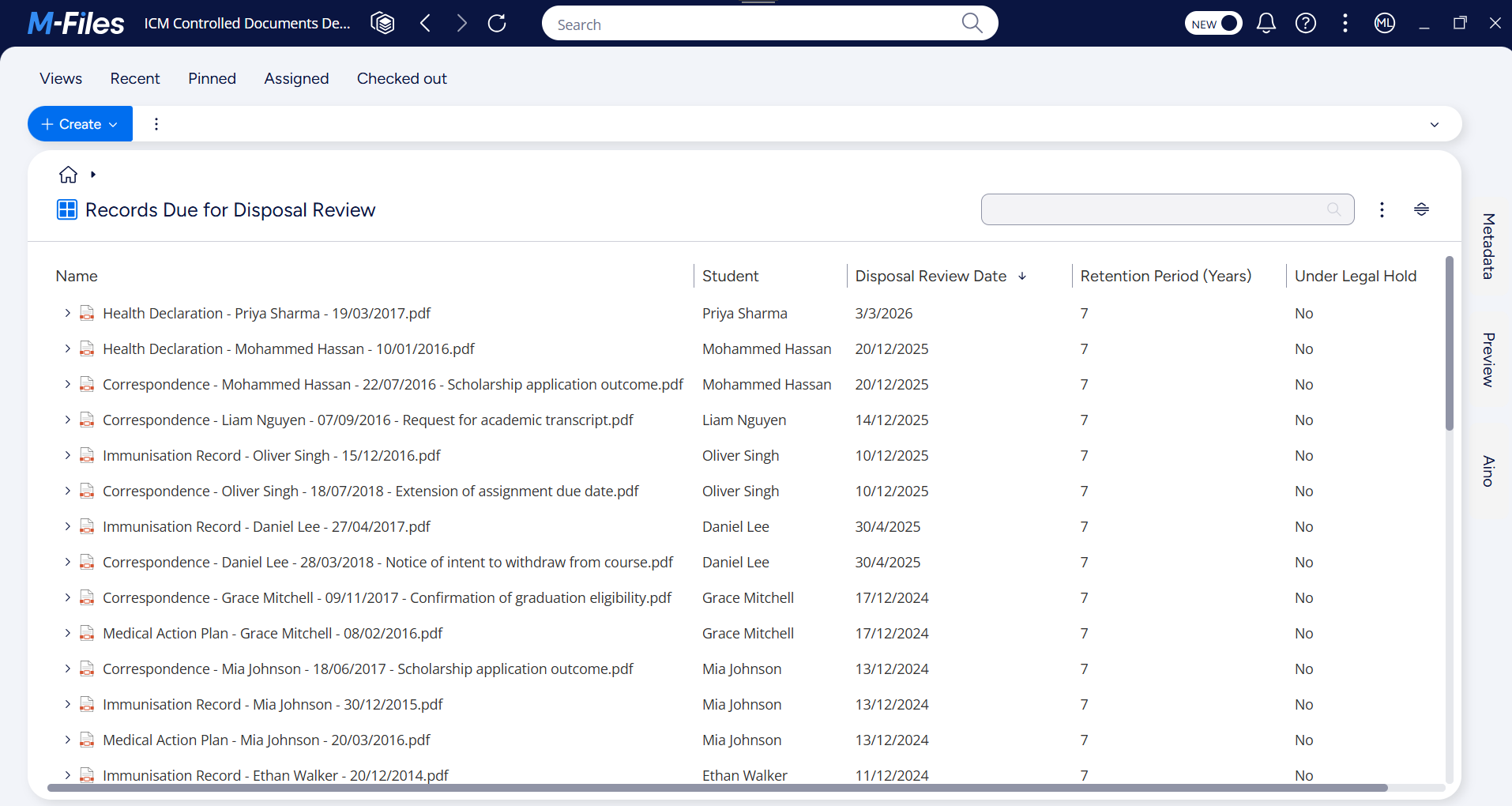
A good system should show exactly which records have passed their retention period, so that authorised staff can review them and approve disposal. The ISQ guide recommends that the principal authorise destruction, that schools keep a register of what was destroyed and when, and that destruction not be entirely automated so that records subject to, or likely to be subject to, legal proceedings are not destroyed by mistake.
4. Legal holds
When a complaint, litigation, or investigation arises in relation to a student, records to a matter need to be frozen so that nothing under hold can be disposed of until the hold is released. A robust system should be able to apply a legal hold condition to the student, which then cascades rules down to the related records to a) pause the retention clock (if applicable), and b) prevent their destruction until the legal hold is released.
5. Policy document control
Policies are an important category of records that schools must maintain. A comprehensive system also manages school policy documents. It streamlines review, approval and publication of policies, and maintains an audit trail of how each policy has evolved. When a new version is published, the system should automatically remove any superseded version from circulation and mark it with metadata, such as the date it was superseded. This is highly valuable when a school must demonstrate which version of a policy was in place at a particular time, for example during an audit or investigation.
6. Integration with the school management system
Ideally, the school management system remains the source of truth for structured data about students, and that information is pushed to the school's electronic document and records management system (EDRMS), where documents and records are linked to each student.
How M-Files Supports Records Management for Schools
M-Files is an information management platform that works alongside Microsoft 365 and school management systems. It suits records management because retention is driven by metadata rather than folders.
Key advantages include:
• Review and approval workflows that take a document through to a declared record
• Automatic PDF conversion on approval
• Retention schedules and disposal authorities applied automatically
• Access permissions that tighten once a record is declared
• Disposal review views showing what is due, with authorisation steps
• Legal holds and tamper-proof audit trails
• Automatic version control and superseded-version handling for policies
Because these controls are enforced by the system, schools rely far less on individual staff remembering the rules.
See how easy M-Files makes capture, classification, and monitoring of student records in our demo video below:
Ready to Streamline your School's Records Management?
Good records management protects children, supports compliance, and takes pressure off busy administration teams. The team at Innovative Content Management designs and implements M-Files solutions for Australian organisations, including records retention and disposal.
Book a free consultation today and we'll help you identify gaps in how your school manages its records, and show you what a purpose-built M-Files solution looks like in action.
More Articles



Share